Embedded Analytics Tools: What to Evaluate Before Buying

Bold BI® empowers businesses to embed interactive dashboards, explore AI-powered analytics, and turn data into actionable insights—all within your apps.
TL;DR: Embedded analytics tools help SaaS companies deliver dashboards and self-service analytics directly within their applications. Before choosing an embedded analytics tool, evaluate factors such as multitenancy, customization, security, scalability, developer experience, AI capabilities, and pricing to ensure the platform can support both current requirements and future growth.
Introduction
Many SaaS companies start with basic analytics to meet customer requirements. Over time, those requests grow into interactive dashboards, self-service analytics, tenant-specific experiences, exports, and role-based access controls.
Building and maintaining these capabilities can quickly become a challenge. Teams must manage security, performance, tenant isolation, and growing data volumes while continuing to develop core product features. This is why many organizations choose embedded analytics tools instead of building analytics from scratch. In this guide, we'll explore the key factors SaaS teams should evaluate before selecting an embedded analytics solution in 2026.
What is embedded analytics?
Embedded analytics refers to the integration of dashboards and data exploration capabilities directly into a SaaS application.
A modern embedded analytics solution enables users to:
Access insights within the application.
Interact with data in real time.
Build custom dashboards without switching tools.
Most platforms provide APIs, SDKs, and embedding options such as iframes and web components.
To learn more about embedded analytics, explore our What Is Embedded Analytics? Benefits, Examples, and Uses blog.
Why evaluating embedded analytics tools matters
Choosing an embedded analytics tool affects more than analytics capabilities. The right platform can reduce development effort, accelerate delivery, improve analytics adoption, and support long-term scalability.
Before selecting a platform, SaaS teams should evaluate whether it can support customer-facing analytics requirements today and continue to meet those needs as the product grows.
Supports SaaS-specific requirements: Features such as tenant isolation, white-labeling, and role-based access are essential for SaaS products but are not available in every platform.
Simplifies integration: Choosing a platform that cannot support future requirements may result in costly migrations and redevelopment.
Supports growth: As customer adoption and data volumes increase, the platform should continue to perform reliably without requiring major architectural changes.
Improves the user experience: Embedded analytics should feel like a natural part of the application rather than a separate tool.
SaaS teams can evaluate platforms based on the capabilities that directly affect implementation and customer adoption.
What to evaluate before buying embedded analytics tools
Adopting the right embedded analytics tool requires evaluating both technical and product-focused criteria. Most SaaS teams compare visible features such as dashboards, security, scalability, AI, and deployment options. However, the strongest evaluations go deeper by asking how each capability works in real SaaS environments.
Before comparing vendors, keep these questions in mind:
How is tenant isolation enforced beyond workspace-level separation?
What happens to dashboard performance during peak customer usage?
Which customization options are configuration-based, and which require development?
How are customer-created dashboards governed, secured, and maintained?
How does pricing change as users, tenants, dashboards, or data volume increase?
Can the platform support future requirements such as embedded analytics, AI-assisted insights, advanced exports, or customer-specific customization?
What support is available for migration, upgrades, and changing analytic needs?
These questions help turn the evaluation from a basic feature checklist into a practical review of scalability, governance, maintainability, and long-term product fit.
With these practical questions in mind, let’s look at the key evaluation areas SaaS teams should prioritize when comparing embedded analytics tools.
1. Multitenant architecture
If customer data is not properly isolated, a single configuration mistake can expose data across tenants. This makes multitenancy one of the most important requirements when evaluating embedded analytics tools.
When comparing platforms, assess whether they provide tenant-level customization, secure access controls, and efficient management across multiple customers.
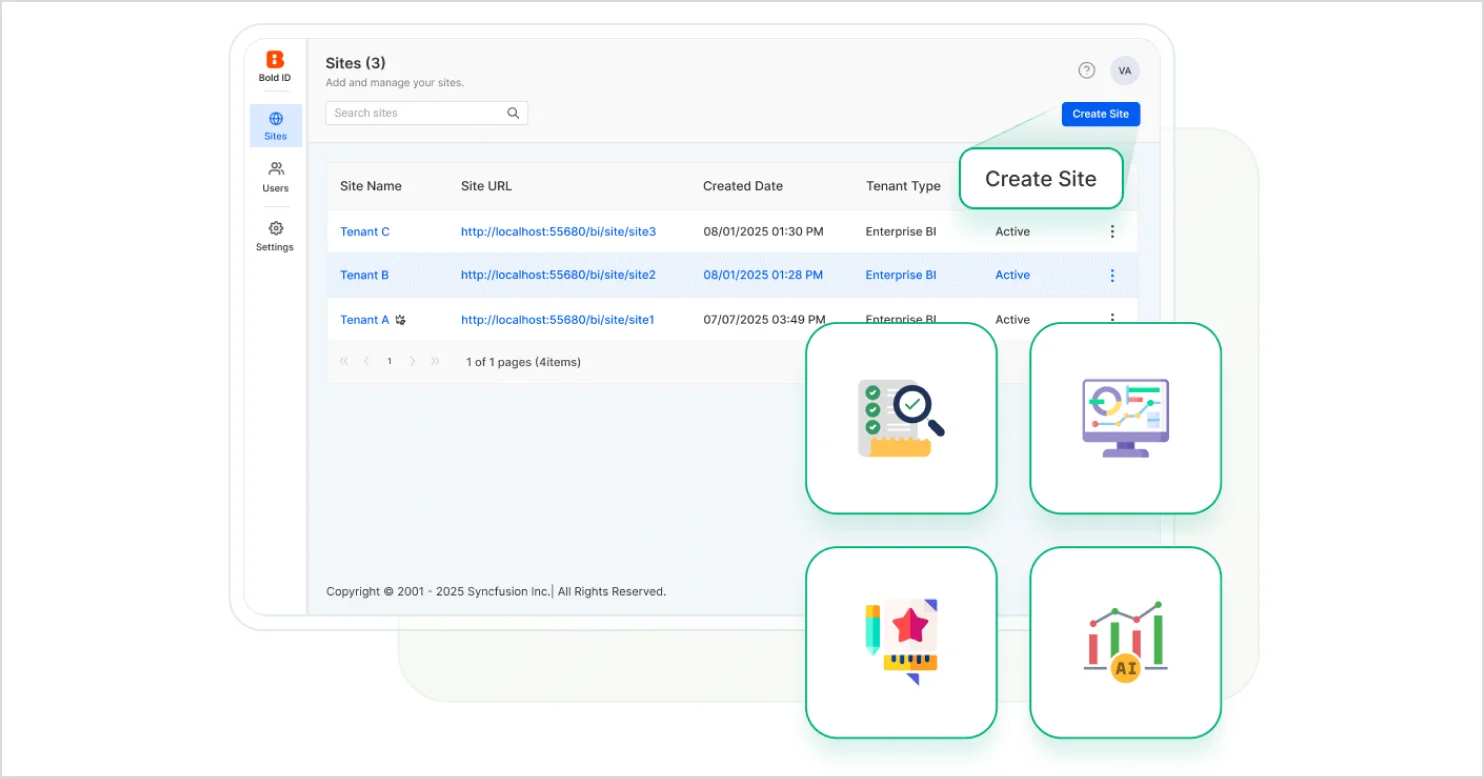
To learn more about evaluating tenant isolation and scalability, explore our Multitenancy: Empowering Insights with Embedded BI blog.
2. White-labeling and customization
If analytics looks and behaves like a third-party tool, adoption can suffer. White-labeling helps create a consistent product experience for customers. Evaluate whether the platform supports branding, layout flexibility, role-based views, and tenant-specific configurations.
The more seamlessly analytics integrates into the product experience, the more likely customers are to adopt and use it regularly.
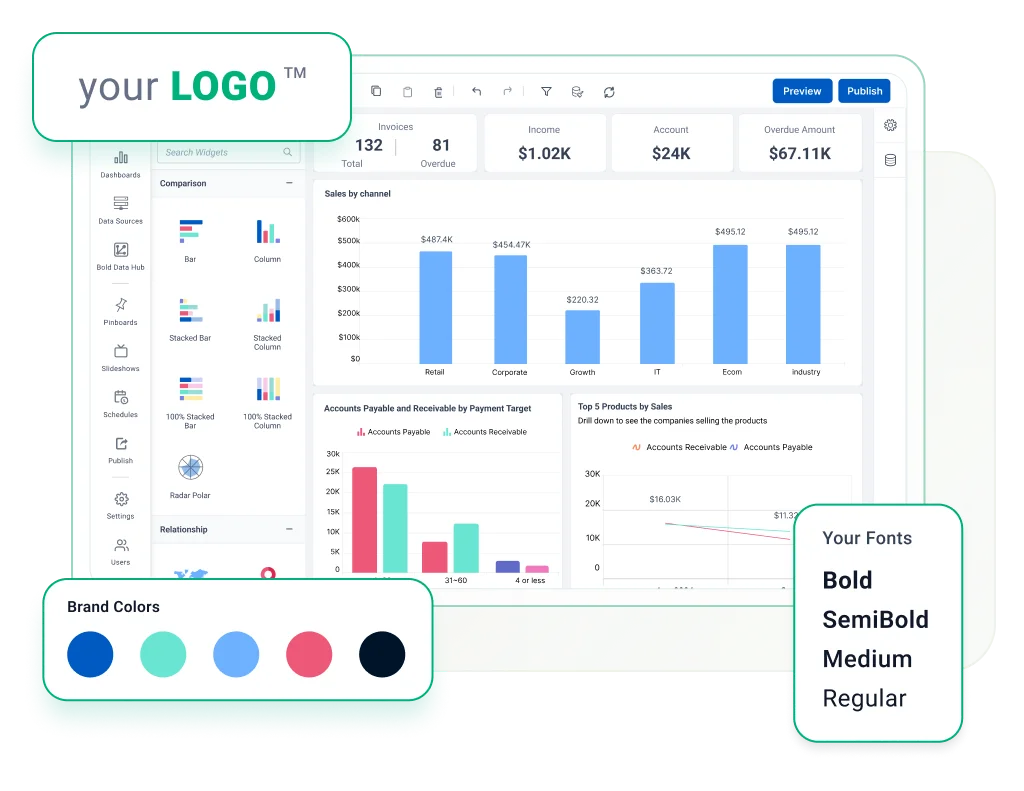
To dive deeper into customization and branding capabilities, explore our White-Label Analytics for SaaS: Features & Benefits in 2026 blog.
3. Self-service analytics capabilities
Modern customers expect more than static dashboards. They want to explore data, customize views, and answer questions on their own. With self-service analytics, users can interact with data independently and make faster decisions.
When evaluating SaaS analytics solutions, check whether users can build dashboards, apply filters, create personalized views, and access insights without developer support.
Strong self-service analytics reduces dashboard requests, lowers support costs, improves customer satisfaction, and helps users discover insights faster.
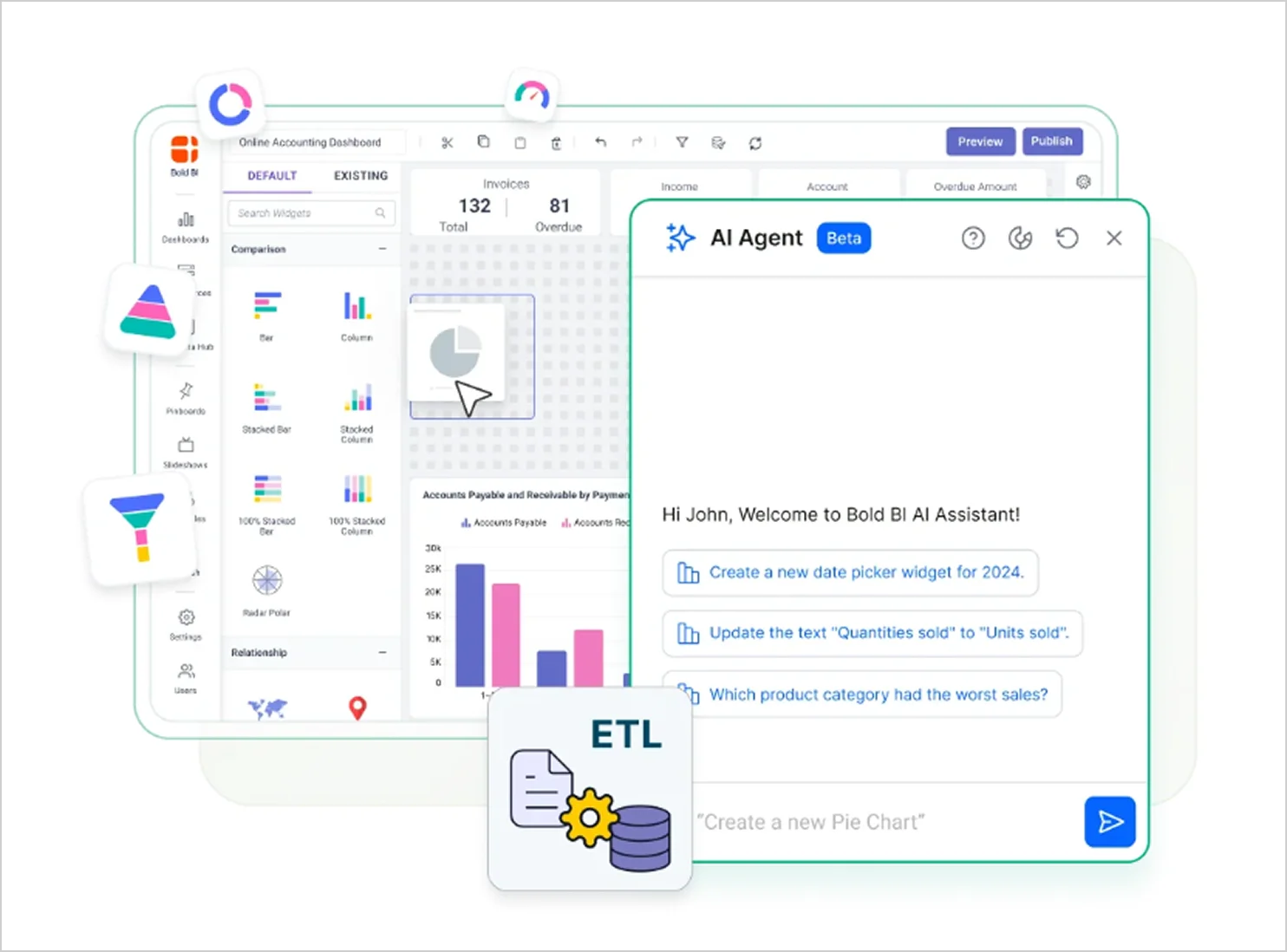
To explore how self-service capabilities improve user-driven data exploration, check out our How Governed Self-Service BI Prevents Data Sprawl blog.
4. Developer experience and integration flexibility
Developer experience directly affects how quickly analytics can be delivered and maintained. A platform should integrate smoothly with your existing application. Assess whether the solution provides robust APIs, SDKs, clear documentation, and flexible embedding options.
A strong developer experience reduces implementation effort, lowers maintenance costs, and enables engineering teams to focus on core product innovation instead of building analytics infrastructure.
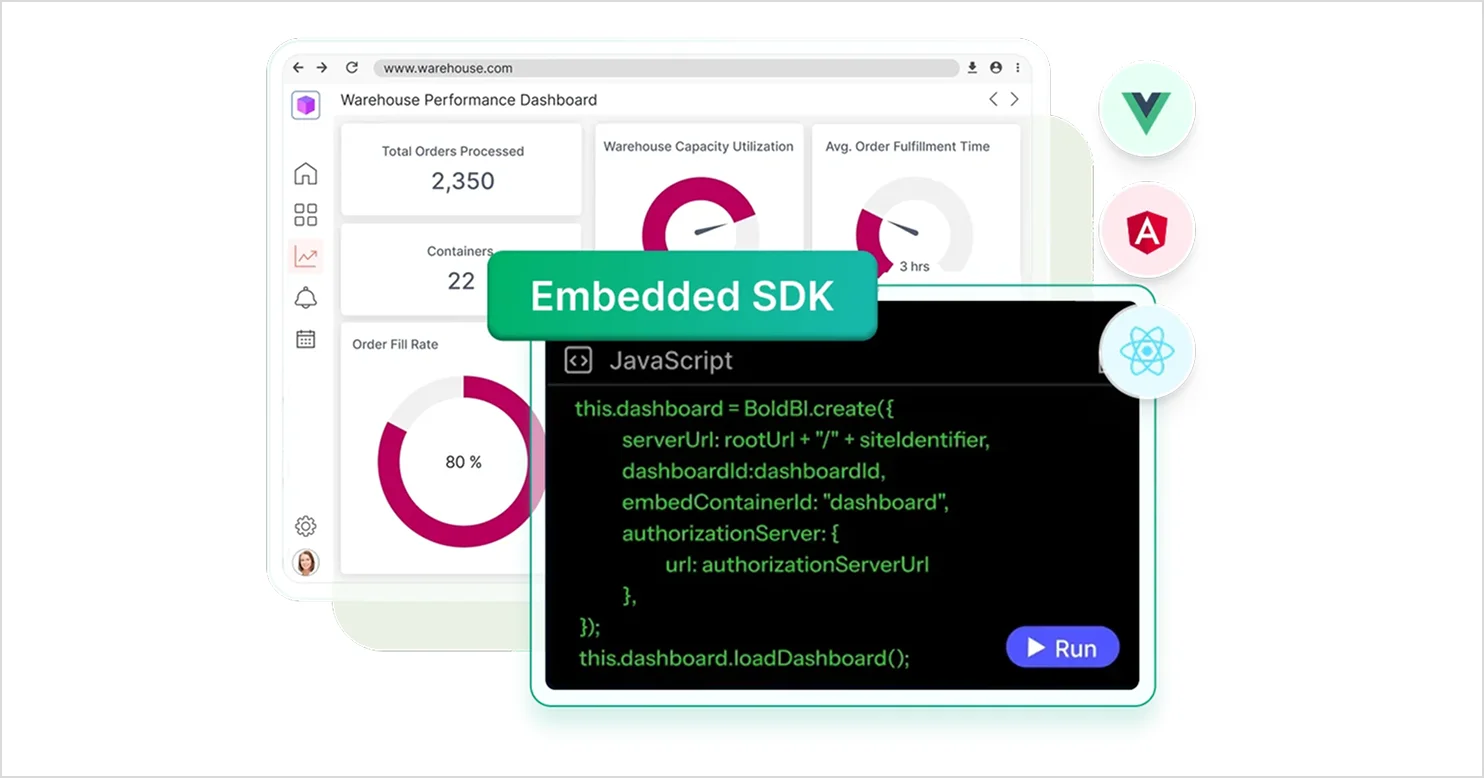
To better understand integration and embedding approaches, explore our Embedded Analytics for SaaS Integration Platforms blog.
5. Security and governance
Security is critical for customer-facing analytics, especially when handling sensitive data. The platform should align with your organization’s compliance and governance standards.
Evaluate capabilities such as SAML or OAuth-based authentication, role-based access control, row-level security, encryption, audit logs, and data residency support. These features ensure secure access and consistent data governance across tenants.
Strong governance ensures users access only the data they are authorized to see.
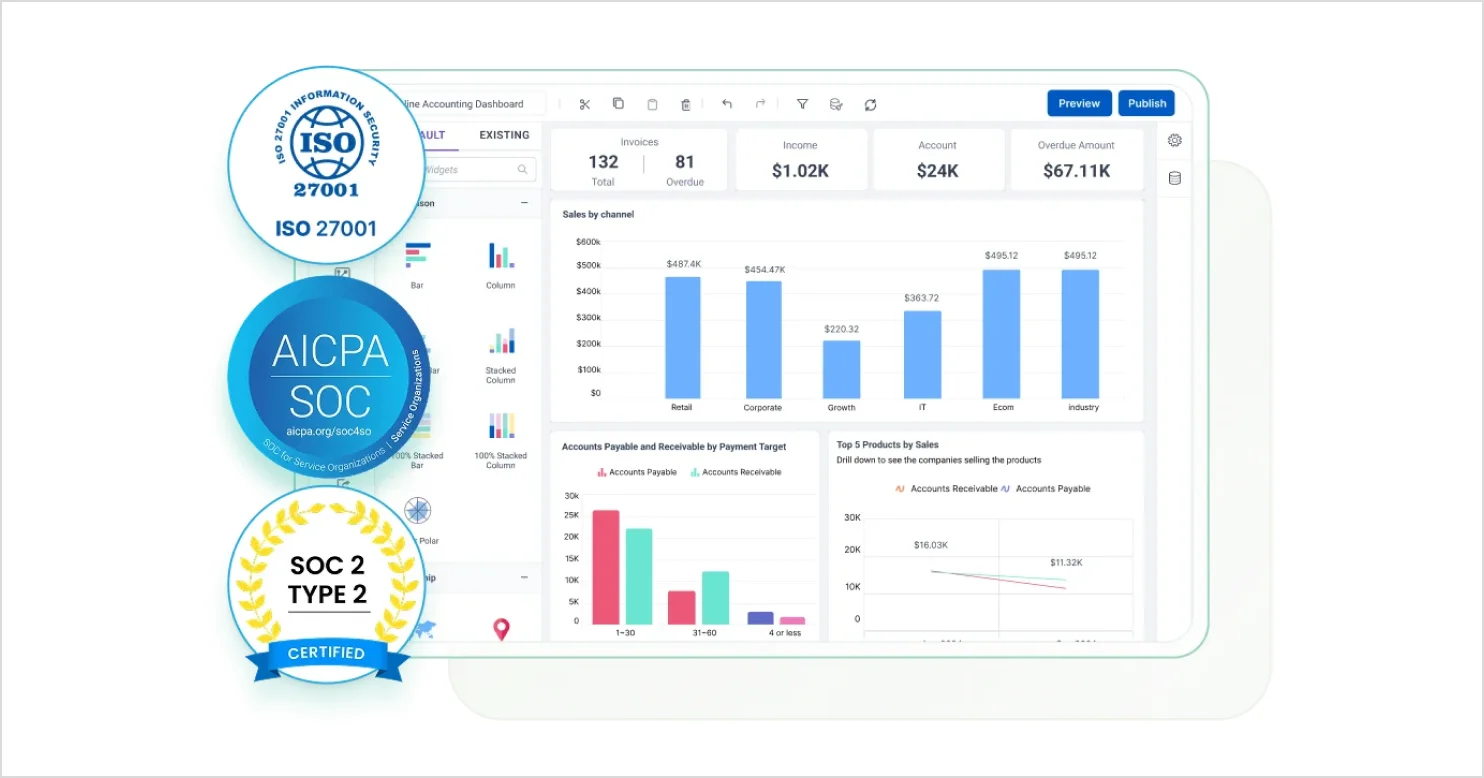
To learn more about securing data and enforcing access control, explore our How to Secure Data with Row-Level Security in Bold BI blog.
6. Scalability and performance
As SaaS products grow, analytics workloads increase in complexity and volume. The platform must maintain consistent performance as usage scales.
Evaluate how the platform handles large datasets, concurrent users, and query performance. Look for support for query caching, pre-aggregation, and horizontal scaling, and verify that tenant workloads remain isolated under high demand.
Consistent performance helps maintain a reliable user experience as adoption increases.
7. Deployment flexibility
Different customers and industries require different deployment models, especially in regulated industries. Evaluate whether the SaaS analytics platform supports cloud and self-hosted environments. Consider data residency options, regional hosting capabilities, and backup and recovery features.
Flexible deployment options help support enterprise customers and regulatory needs.

To learn more about choosing the right deployment approach, explore our Choosing the Right BI Deployment Model: Cloud vs On-Premises blog.
8. AI-powered analytics and future readiness
AI capabilities have quickly become a major consideration when evaluating embedded analytics platforms. However, not all AI features deliver the same value.
Rather than simply asking whether a platform includes AI, evaluate how AI improves the overall analytics experience.
Consider questions such as:
Can users generate dashboards using natural language prompts?
Does AI explain trends, anomalies, and business drivers, or only generate visualizations?
Can users ask follow-up questions conversationally?
Are AI-generated insights governed by existing security and access controls?
Does AI reduce dependency on analysts and support teams?
The most effective AI-powered analytics platforms help users move from questions to decisions faster while maintaining governance, accuracy, and trust.
To explore how AI enhances analytics and decision-making, check out our What is AI Analytics? Why It Matters & 4 Industry Use Cases blog.
9. Transparent and predictable pricing model
Pricing affects long-term scalability and cost predictability. An unclear pricing structure can lead to unexpected expenses as usage grows.
Evaluate whether pricing is based on users, usage, or a combination of the two. Review potential hidden costs such as API usage, data volume, or embedding limits to ensure the model aligns with your growth plans.
After evaluating these criteria, assess whether the platform fits your SaaS product’s technical requirements, customer experience goals, and long-term growth plans. Next, let’s explore the warning signs that may affect implementation, scalability, or customer adoption.
Common risks to watch for during analytics platform evaluation
Not every analytics platform is designed for embedded SaaS use cases. Identifying warning signs early can help teams avoid expensive mistakes.
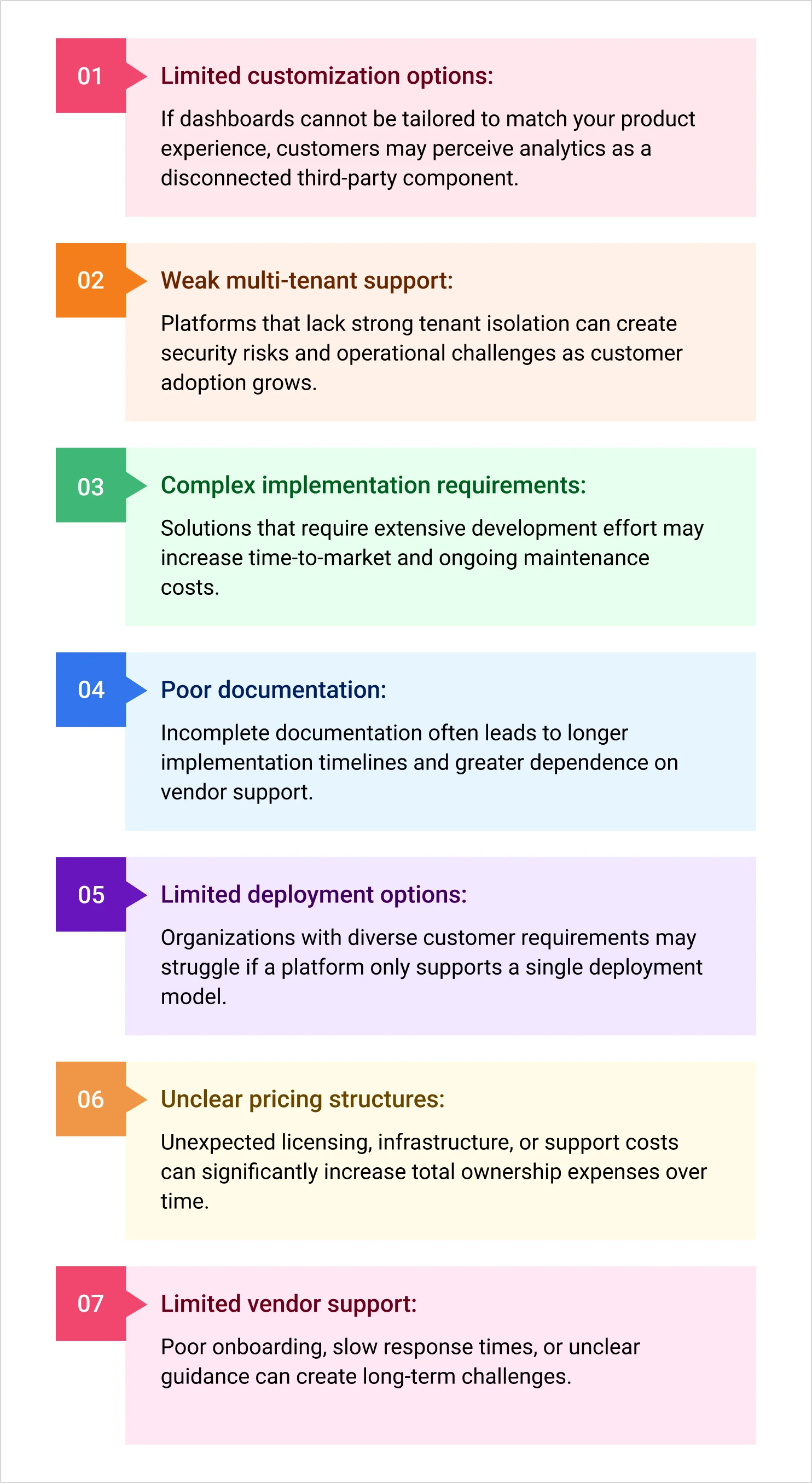
Recognizing these red flags early can help SaaS teams focus on vendors that align with long-term business goals.
Build vs. buy embedded analytics tool: What is the right approach?
Before selecting an embedded analytics platform, SaaS teams must decide whether to build analytics in-house or use an existing solution.
Building offers full control but requires significant effort in development, scaling, and ongoing maintenance. Buying, on the other hand, allows teams to use an embedded analytics tool with ready-made features, faster implementation, and reduced engineering overhead.
If your team spends more time maintaining dashboards, permissions, and analytics features than building core product capabilities, it may be time to evaluate an embedded analytics platform. The right choice depends on your resources, timeline, and product complexity.
To better understand how to evaluate this decision and its long-term impact, refer to these resources:
Build vs Buy Analytics: Which Is Better for Your Business: Explains the trade-offs between building analytics internally and adopting a pre-built solution, focusing on cost, scalability, and maintenance.
Choosing Embedded BI: Build or Buy: Provides a focused comparison to help SaaS teams evaluate embedded BI solutions based on development effort, flexibility, and time-to-market.
Why Embedded BI is Better than Custom-Built BI Solutions: Compares embedded BI and custom-built BI approaches, highlighting the advantages of embedded solutions in areas such as time-to-market, development costs, scalability, maintenance, integration, and access to continuous innovation.
Understanding the trade-offs between building and buying analytics capabilities helps establish the key criteria for platform selection. However, seeing how these requirements apply in a real SaaS environment can provide additional context for the evaluation process.
Real-world application
The following example shows how these evaluation factors can influence a real-world SaaS company's embedded analytics decision.
ai-InteleKt improves embedded analytics delivery with Bold BI
ai-InteleKt needed a dashboarding and reporting platform that could help its customers build custom dashboards quickly and easily. The team also needed a solution that could be embedded inside its application and remain economical for the business.
Bold BI provided ai-InteleKt with an intuitive, drag-and-drop dashboarding environment that was easy to train users on while still supporting more advanced functions when needed. Its embedding capabilities also aligned with ai-InteleKt’s application requirements.
With support from the Bold BI team, ai-InteleKt was able to move its product to market more quickly.
As a result, ai-InteleKt gained:
A platform that is easy to embed in applications.
Dashboards and reports that are easy to build and customize.
Access to a responsive support team.
Supported flexible dashboard customization.
A solution Ravi Srinivasan recommended for its price, performance, and support.
This example shows why SaaS teams should evaluate more than feature availability. Ease of embedding, dashboard customization, user training, and vendor support can have a significant impact on the success of an embedded analytics initiative.
How Bold BI supports embedded analytics requirements
The following table maps common evaluation criteria to the capabilities SaaS teams typically look for when selecting an embedded analytics platform.
| Evaluation area | How Bold BI addresses it |
|---|---|
| Multitenancy | Helps manage multiple customers with tenant-level separation and administration |
| White-labeling | Lets teams match dashboards to their product branding, themes, and layouts |
| Self-service analytics | Allows users to create and explore dashboards without relying on developers for every change |
| Developer experience | Provides APIs, SDKs, and embedding options for integrating analytics into existing applications |
| Security and governance | Helps protect customer data with role-based access, row-level security, SSO, and auditing |
| Deployment flexibility | Supports cloud and on-premises deployment so teams can meet different customer or compliance needs |
| AI-powered analytics | Helps users explore data with natural language queries and AI-assisted insights |
| Scalability | Supports growing datasets, user activity, and dashboard workloads as analytics adoption increases |
| Data connectivity | Allows teams to connect to 140+ data sources, making it easier to combine application, business, and customer data in a single analytics experience |
| Collaboration | Enables teams to share dashboards and insights across users or departments |
By combining these capabilities within a single platform, Bold BI helps SaaS organizations embed analytics while reducing development effort and supporting long-term scalability.
Get started with the right embedded analytics tools
Choosing the right platform requires more than feature comparison. It must fit your product, scale with your users, and deliver seamless embedded analytics for SaaS.
Bold BI® is built with these needs in mind, combining native multitenant support, flexible embedding, and deep customization. It gives SaaS teams the control and performance needed to deliver analytics as a true part of the product experience.
Ready to find the right embedded analytics platform for your SaaS product? Explore how Bold BI simplifies embedding, scales with your growth, and delivers a seamless analytics experience by signing up for a free trial.
Related resources:
Frequently asked questions
What is embedded analytics for SaaS?
Embedded analytics for SaaS is the integration of dashboards and data exploration features directly into a SaaS application, allowing users to access insights without leaving the product.
Why is embedded analytics important for SaaS products?
It improves user experience by bringing insights into the workflow, increases engagement, and helps SaaS teams deliver more value without requiring users to switch tools.
What should teams look for in a SaaS analytics platform?
Teams should evaluate multitenancy, customization, developer integration, security, scalability, and deployment flexibility when selecting a SaaS analytics platform.
How does an embedded analytics tool improve user experience?
An embedded analytics tool allows users to explore and interact with data directly within the application, which improves decision-making and reduces dependency on external tools.
What are common challenges when implementing embedded analytics?
Common challenges include integration complexity, limited customization, weak multitenant support, and unclear pricing models.
How can SaaS teams evaluate scalability?
Teams should assess how the platform handles concurrent users, large datasets, and query performance, along with features such as caching and workload management.
Should SaaS teams build or buy analytics capabilities?
This depends on available resources, time-to-market goals, and product complexity. Many teams choose to buy to reduce development effort and scale faster.
Can users ask questions in natural language with embedded analytics tools?
Many embedded analytics tools support natural language queries, allowing users to ask questions in plain language and receive relevant insights.


